
Artificial Intelligence (AI) is everywhere.
Every conference, boardroom, social media platform, webinar, and classroom conversation seems consumed with discussions about AI agents, generative AI, copilots, automation, and prompt engineering. And rightfully so. Artificial intelligence has already transformed how we work, create, communicate, and access information. It will continue reshaping society in ways we are only beginning to understand.
But there is another conversation emerging beneath the surface of the AI boom.
It is the intersection where Extended Reality (XR) meets Artificial Intelligence.
It is where intelligence stops being confined to a screen and becomes an experience.
I call this Immersive Intelligence.
Immersive Intelligence is the fusion of AI and XR technologies — virtual reality, augmented reality, mixed reality, and spatial computing — to create adaptive, embodied, responsive environments that teach, guide, simulate, support, and evolve in real time alongside the user.
This is not merely AI answering questions in a chat window.
This is intelligence embedded into environments.
This is AI becoming spatial.
This is learning becoming experiential.
This is where the future begins to feel less like software and more like reality itself.
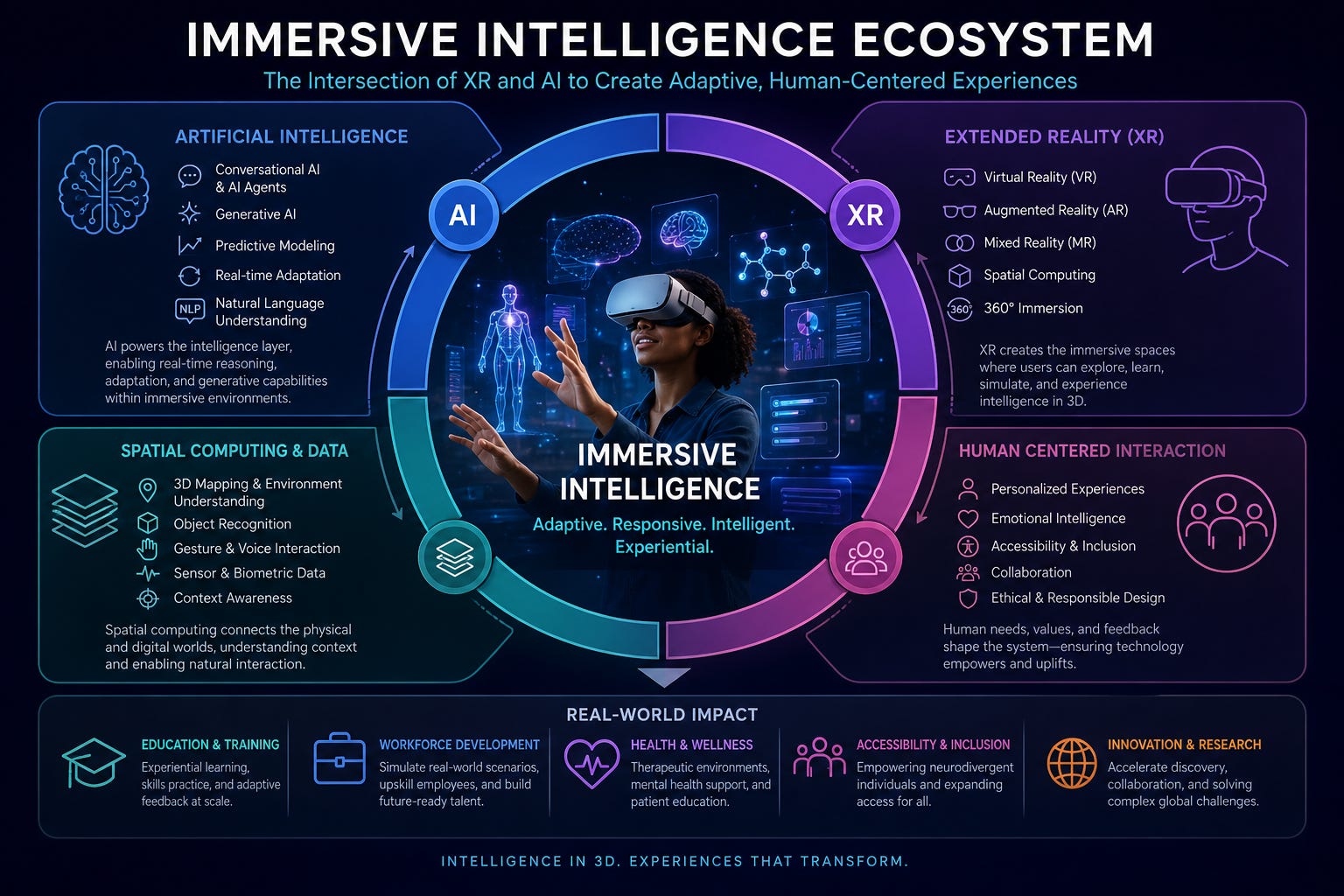
Immersive Intelligence Ecosystem” diagram showing AI + XR + Spatial Computing + Human Interaction converging into one adaptive experience.
For years, we have interacted with computers through flat interfaces. We typed into machines and received responses back. But Immersive Intelligence changes the relationship entirely because users are no longer outside the system looking in.
They are inside the experience itself.
Instead of simply reading about anatomy in a textbook, learners can enter a living anatomical simulation and prompt AI to generate inflammation, disease progression, or physiological stressors that dynamically alter organ systems before their eyes. Students could watch blood vessels constrict during hypertension, observe respiratory failure develop in real time, or visualize how neurological disorders impact communication pathways throughout the body.
The environment itself becomes responsive to inquiry.
Instead of memorizing facts, learners investigate living systems.
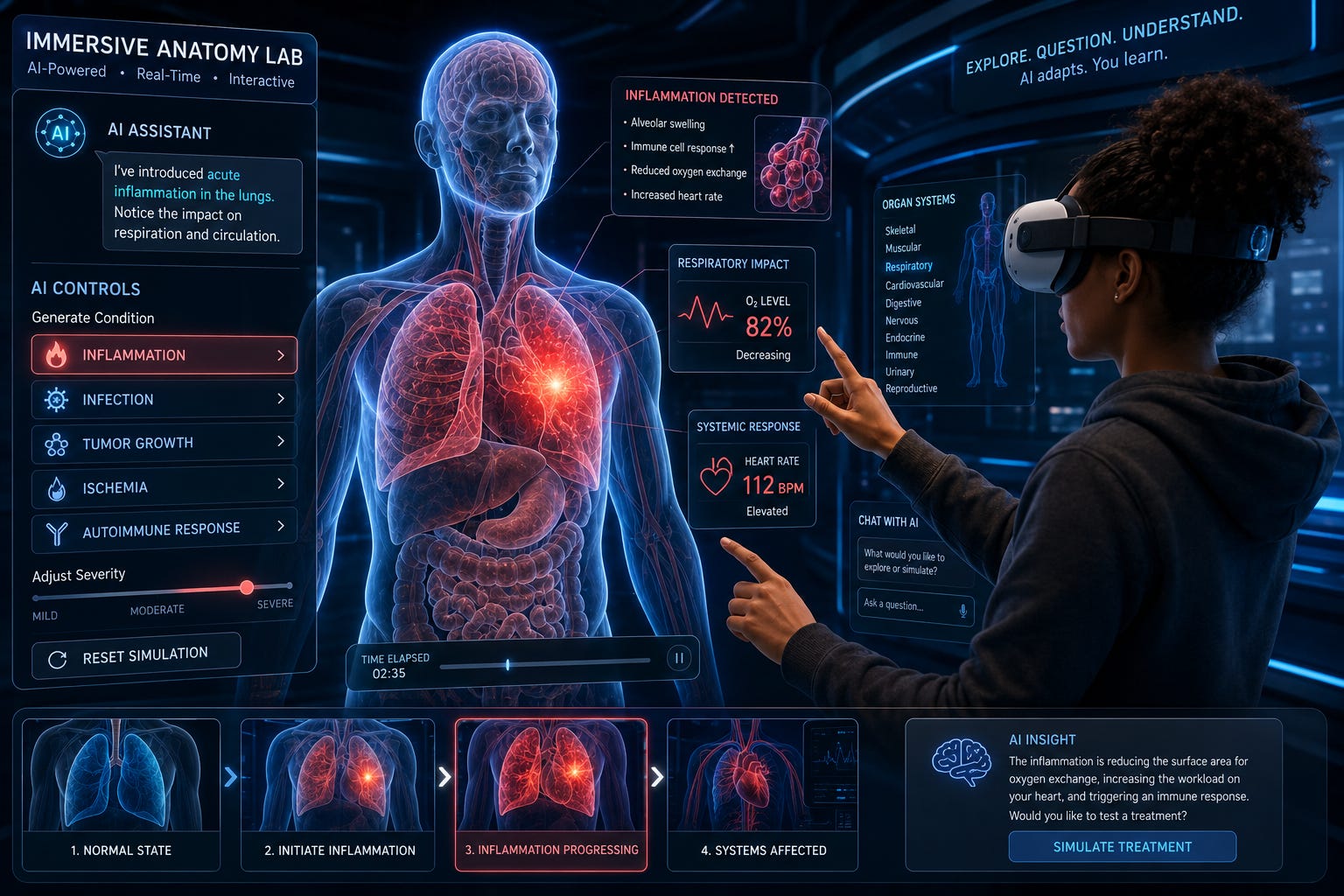
Student inside immersive anatomy environment interacting with AI-generated inflammation spreading through organ systems.
The same is true in chemistry and molecular sciences.
Instead of merely rotating a static molecular structure in 3D space, students can manipulate molecules and use AI to generate entirely new environmental conditions to see how compounds react under varying temperatures, pH levels, pressures, radiation exposure, or chemical interactions.
Imagine a chemistry student asking:
“What happens if this protein denatures under extreme heat?”
“What if oxygen availability decreases?”
“What if acidity increases?”
And then watching the molecular environment transform instantly in front of them.
The learner is no longer passively consuming information.
The learner is experimenting inside an intelligent system capable of simulating consequence in real time.
As a biomolecular chemist, this possibility excites me deeply because spatial understanding has always been one of the hidden barriers in science education. Many students struggle not because they lack intelligence, but because they cannot mentally visualize complex systems dynamically.
Immersive Intelligence changes that.
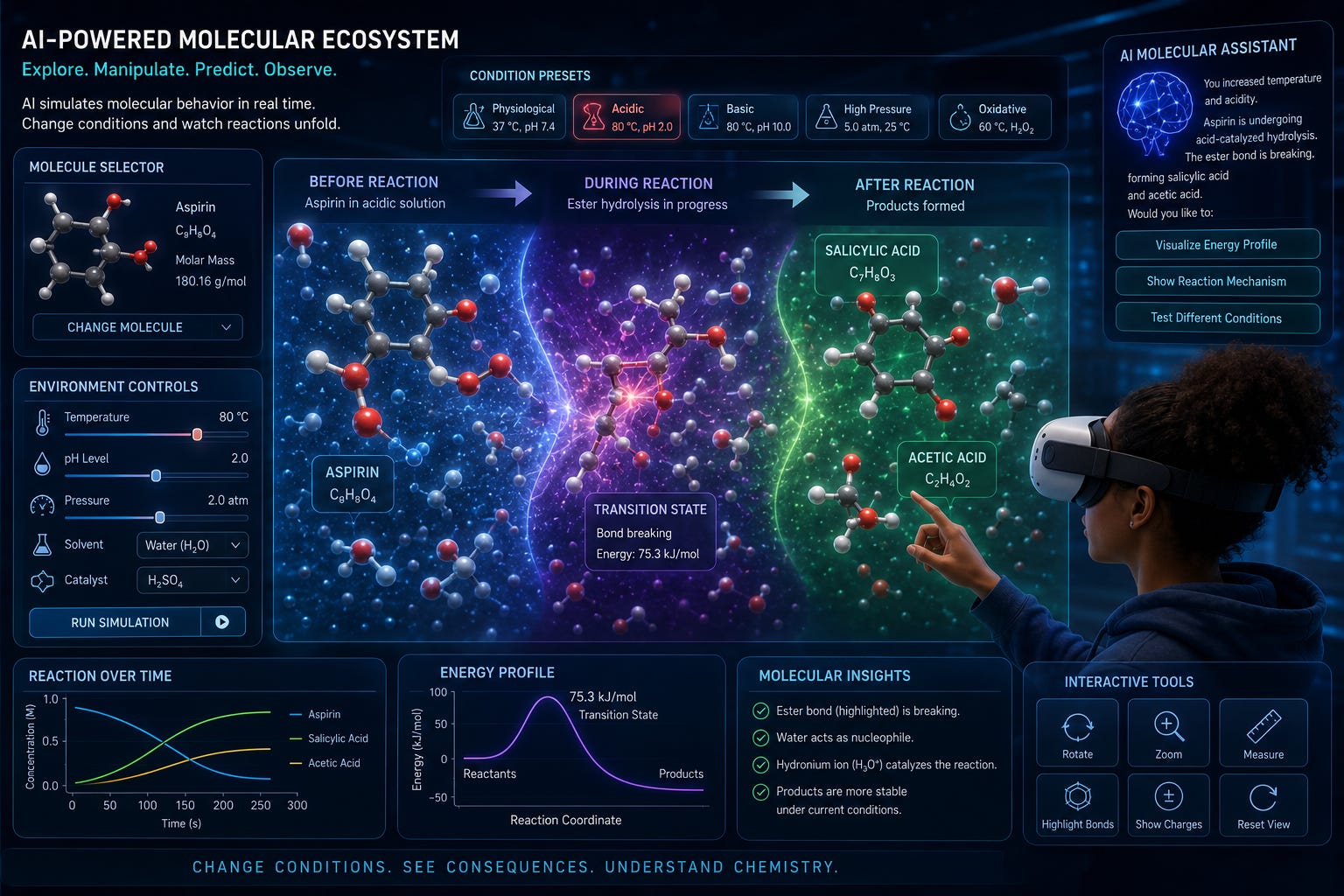
AI-generated molecular ecosystem showing reactions dynamically changing under altered environmental conditions.
But the implications extend far beyond STEM education.
Imagine workforce training environments where employees can rehearse emotionally charged or dangerous scenarios within mixed reality systems generated and adapted by AI.
A healthcare worker could practice de-escalating an aggressive patient encounter.
A school administrator could rehearse responding to a school crisis.
A first responder could train within evolving emergency scenarios where environmental conditions change dynamically based on decisions made in the moment.
A customer service professional could practice navigating emotionally difficult interactions with AI-driven virtual humans capable of displaying frustration, confusion, grief, anxiety, or urgency.
The environment itself adapts to the learner’s behavior.
The simulation becomes intelligent.
And because the scenarios can be rehearsed repeatedly in psychologically safe environments, individuals build confidence before high-stakes moments happen in real life.
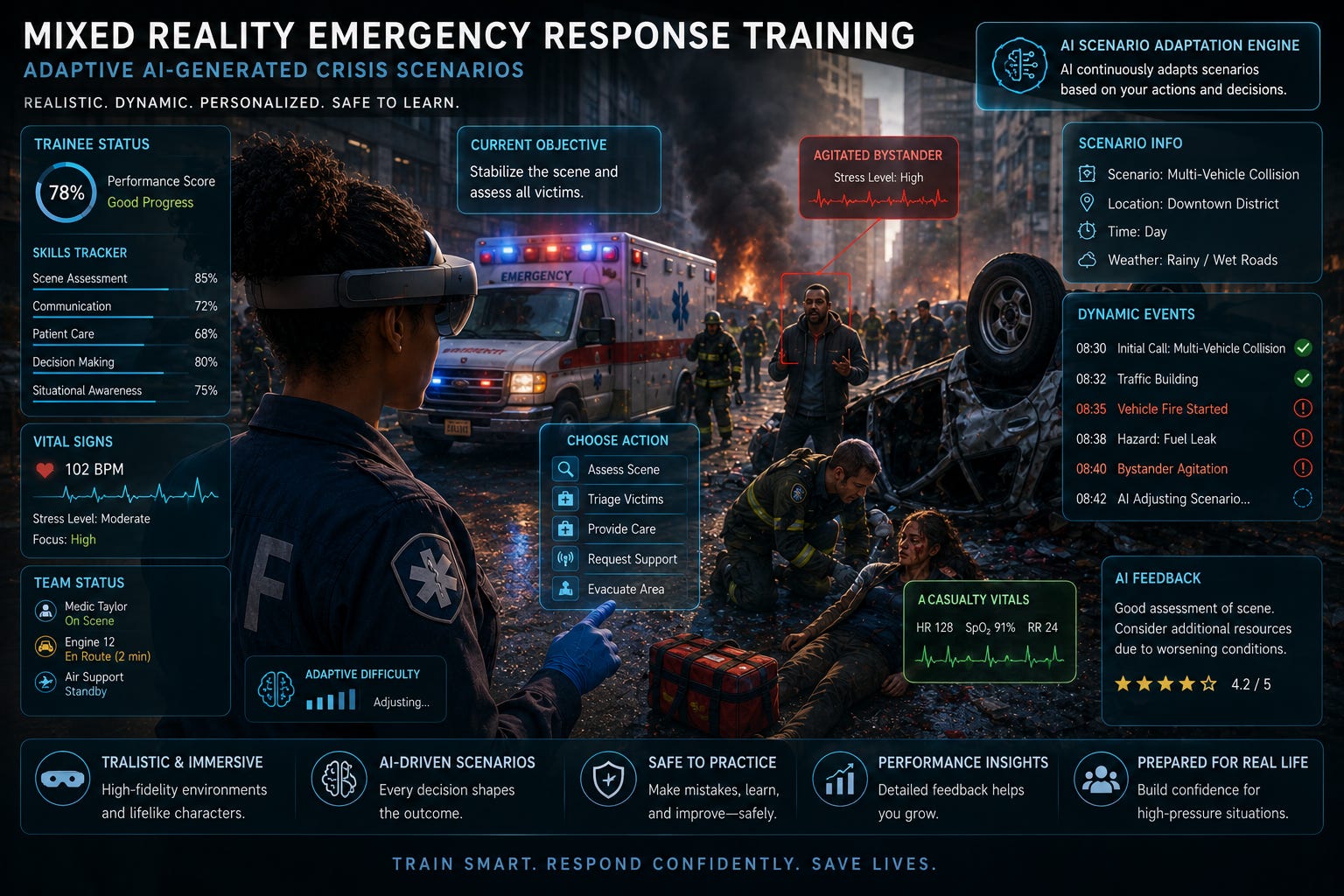
Mixed reality emergency response training environment with adaptive AI-generated crisis scenarios.
This is why I believe education, training, and workforce development will become the fastest path toward mainstream adoption of Immersive Intelligence.
The value proposition is immediate.
People learn best when they can interact, experiment, fail safely, receive feedback, and try again.
Immersive Intelligence creates exactly that kind of ecosystem.
One of the most compelling examples I have personally seen comes from VictoryXR in collaboration with Aurora University.
In this implementation, future educators step into AI-powered virtual classrooms populated by intelligent student avatars with varying personalities, learning styles, cultural backgrounds, engagement levels, and neurotypes.
The teacher candidate lectures in real time.
The AI students ask questions.
Some disengage.
Some become confused.
Some challenge ideas.
Some require differentiated approaches.
The educator must adapt dynamically while teaching.
Afterward, the system evaluates engagement strategies, questioning techniques, classroom management effectiveness, responsiveness, and instructional delivery.
This is transformative because great teaching has never simply been about content delivery.
Great teaching is relational.
Adaptive.
Emotional.
Contextual.
Immersive Intelligence allows educators to rehearse those complexities safely before entering live classrooms.
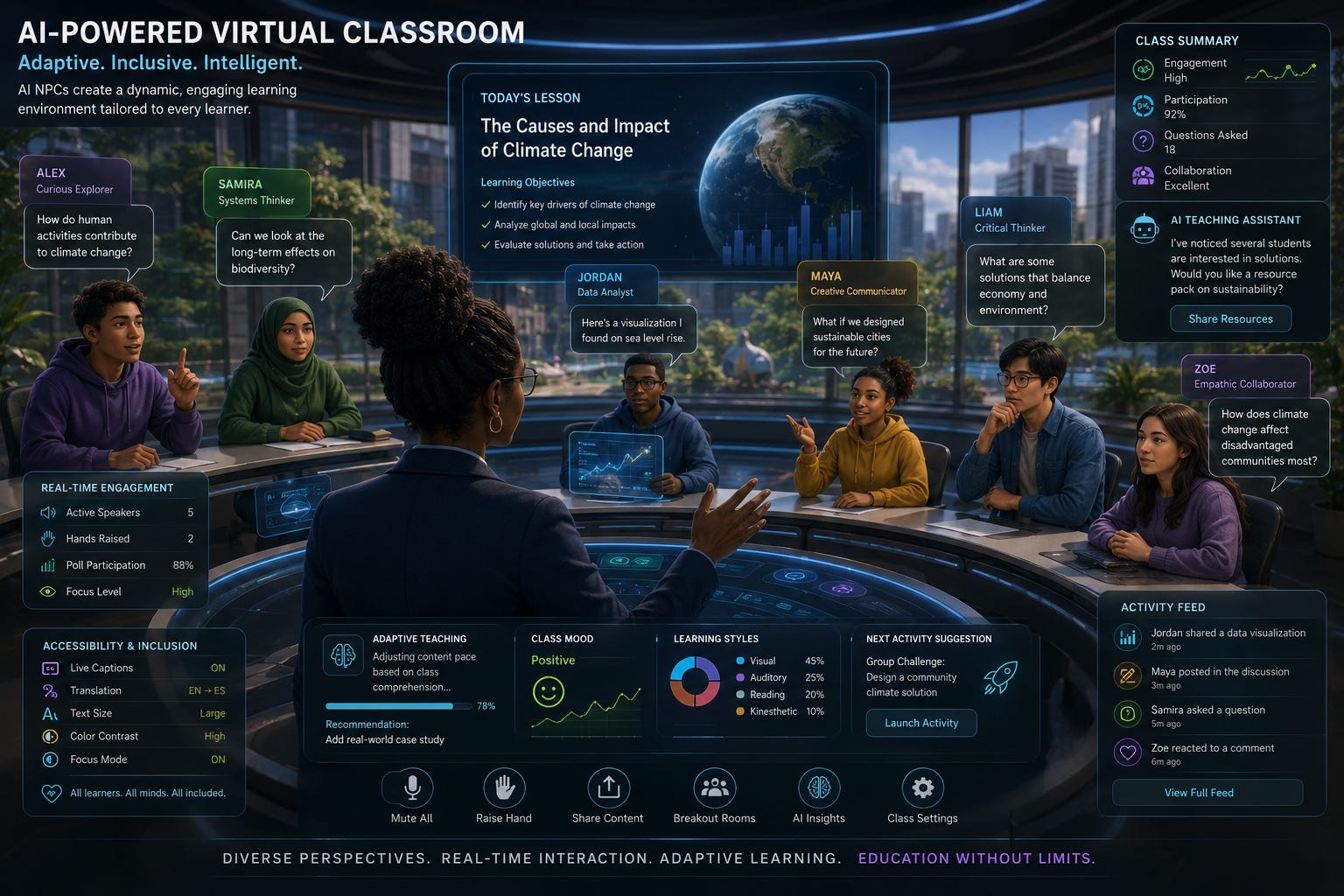
AI-powered virtual classroom with diverse student NPCs interacting dynamically with educator.
Another fascinating example comes from PsyTechVR, where Immersive Intelligence is being used to support mental wellness and therapeutic interventions.
PsyTechVR allows clinicians and users to generate AI-powered immersive “safe place” environments that adapt dynamically to emotional and therapeutic needs.
Imagine someone navigating exposure therapy for PTSD, severe anxiety, or phobias.
As emotional overwhelm begins escalating, the individual can retreat into an AI-generated restorative environment designed specifically for emotional regulation.
The system may soften environmental stimuli, generate calming landscapes, adjust lighting, alter soundscapes, reduce sensory intensity, or introduce grounding visual elements in real time.
This is not escapism.
It is intelligent therapeutic scaffolding.
It is responsive emotional support.
It is technology designed to help regulate the nervous system rather than overstimulate it.
And perhaps most importantly, it demonstrates that Immersive Intelligence is not only about productivity.
It can also be about healing.
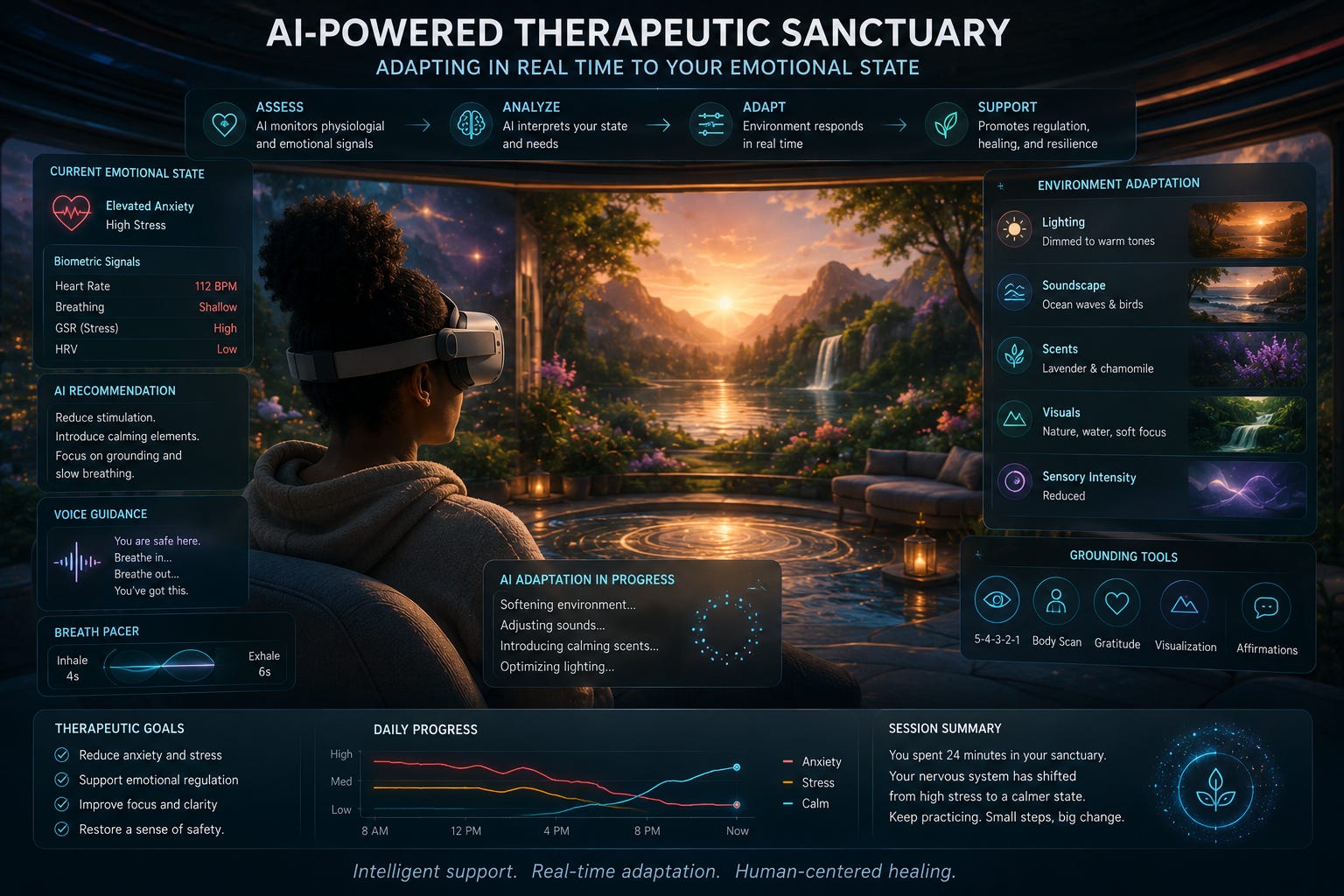
AI-generated therapeutic sanctuary environment adapting dynamically to emotional state.
This brings me to work that is especially close to my heart.
In the Morris Research and Innovation (MRI) Lab, I am exploring how AI-powered Meta Ray-Ban smart glasses and spatial computing systems may support neurodivergent individuals as they navigate the world around them.
For many neurodivergent individuals, daily life can involve enormous cognitive overload. Executive functioning demands, sensory processing, transitions, social cue interpretation, environmental unpredictability, and contextual ambiguity can become exhausting.
Now imagine wearable immersive intelligence systems capable of providing contextual support in real time.
Imagine glasses that assist with navigation, reminders, emotional regulation prompts, environmental awareness, task sequencing, or social interpretation while remaining integrated into everyday life.
Imagine AI that understands not only language, but context.
Not only commands, but human need.
This moves immersive intelligence beyond the headset.
It becomes ambient.
Embedded.
Assistive.
Compassionate.
And this is where I believe the future of AI must go if we truly want technology to serve humanity well.
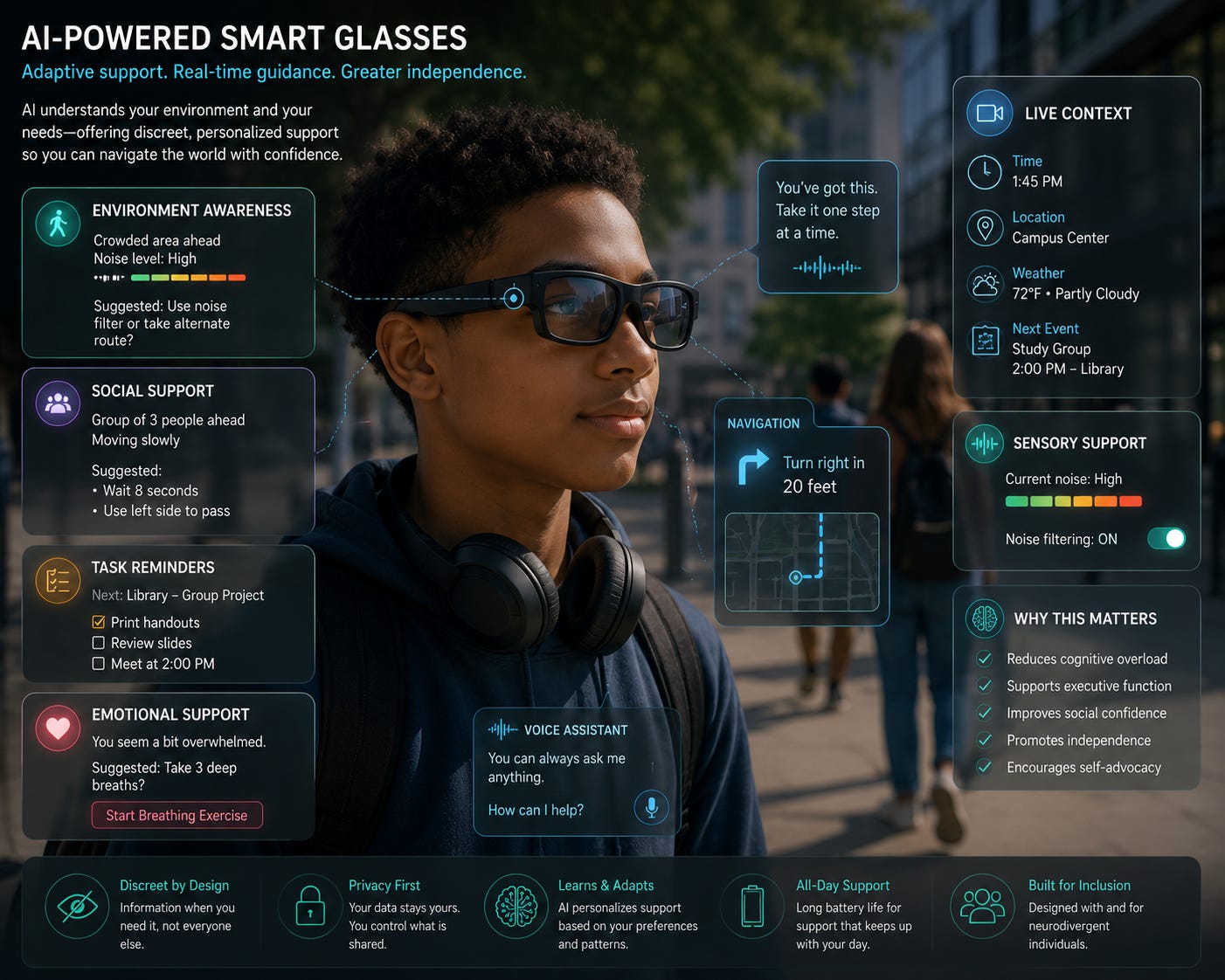
Neurodivergent user wearing AI-powered smart glasses receiving adaptive contextual support in real-world environment.
But with all innovation comes responsibility.
Immersive Intelligence also raises serious questions about ethics, privacy, biometric data, surveillance, accessibility, consent, and algorithmic bias.
Who owns the data generated inside immersive environments?
How do we protect users from manipulative systems?
How do we ensure neurodivergent individuals are supported rather than monitored?
How do we prevent immersive systems from becoming emotionally exploitative?
How do we build environments that remain human-centered?
These questions matter deeply because immersive systems are inherently more intimate than traditional computing. They collect behavioral data, spatial information, emotional responses, eye movement patterns, vocal tone, physiological reactions, and environmental context.
That means ethical design cannot be an afterthought.
It must become foundational infrastructure.
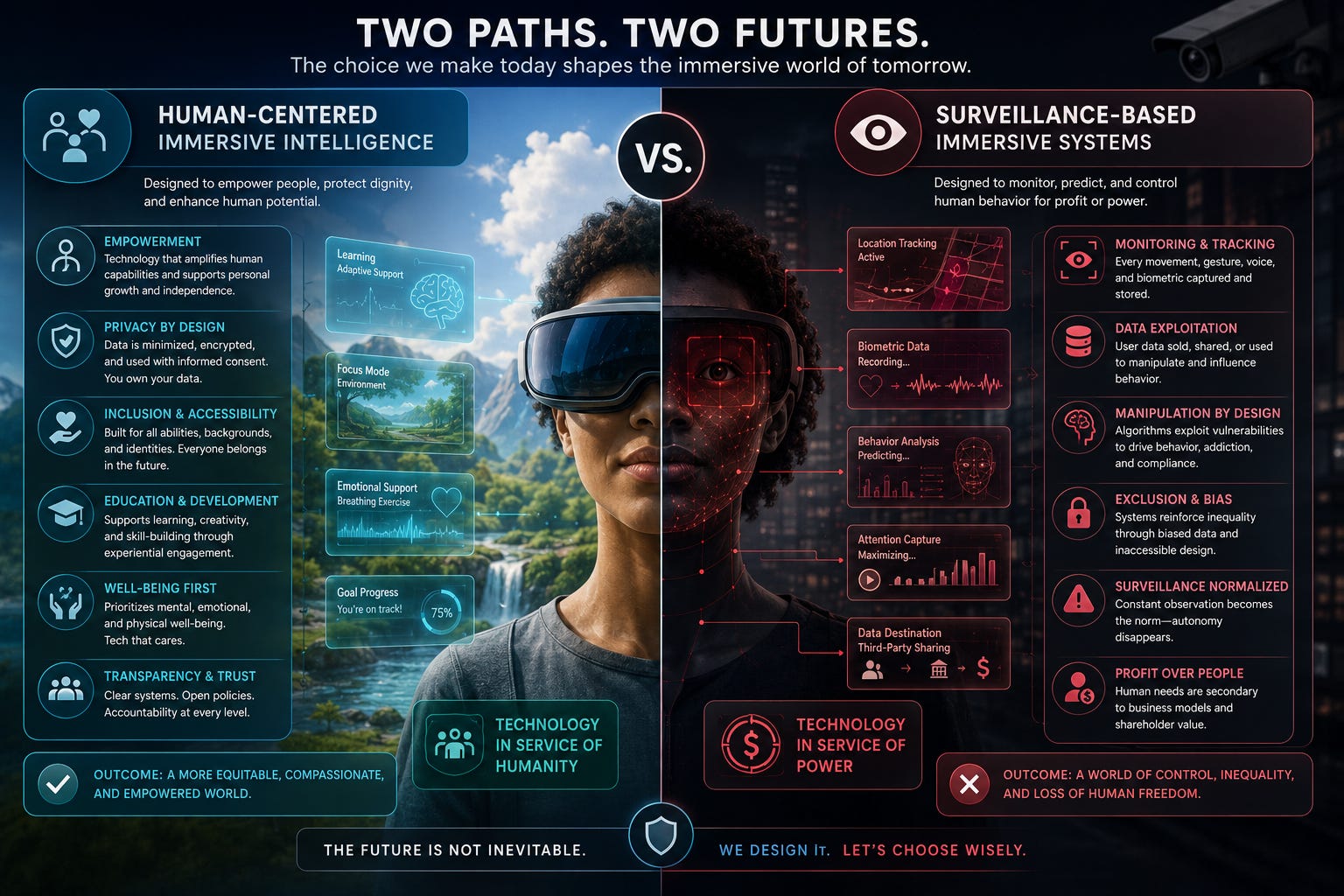
Split-screen graphic showing “Human-Centered Immersive Intelligence” vs “Surveillance-Based Immersive Systems.”
Ultimately, this is why I believe Immersive Intelligence deserves its own category of discussion.
Because this is not simply about smarter chatbots.
It is not simply about automation.
It is not simply about AI-generated content.
It is about intelligence becoming embodied inside adaptive environments that teach, support, regulate, simulate, and evolve with us.
The future will not only be intelligent.
It will be immersive.
And the organizations, institutions, educators, researchers, and innovators who understand this intersection early will help shape the future of learning, healthcare, workforce development, accessibility, and human experience itself.
The real promise of Immersive Intelligence is not that machines become more human.
It is that technology helps humans become more capable, more supported, more informed, more confident, and more connected to one another.
That is the future worth building.
Sources & Further Reading: